
How to Carry Your Recumbent Bike or Trike
One of the most frequent questions we get here at Basically Bicycles is “How do I put that recumbent bike on my car?” Here’s what you need to know about choosing a car rack to carry your new recumbent bike, recumbent trike or other bicycle.
Consider your needs and preferences. How many bikes or trikes do you need to carry? How much do your bikes or trikes weigh? How do you feel about lifting your recumbent bike or recumbent trike over your head? Will you park in a garage with low clearance? Will you need to carry other gear, such as skis or kayaks, on the rack? How many passengers will you carry with the bikes?
Pay close attention to the weight capacity of the racks, especially if your bike or trike is equipped with electric assist or you are carrying multiple bikes or trikes. You may need heavy duty racks to handle your gear safely.
Keep in mind that not all racks will fit all vehicles. Your choices may be limited by the make, model and year of your vehicle. Although most recumbent bikes will fit on traditional style racks, some racks are better suited for recumbent bikes than others. We carry racks that are well-suited for recumbent bicycles and trikes.
Rack types
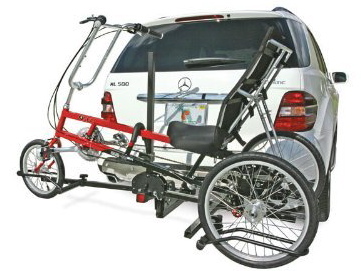 Hitch mount racks
Rack are available to fit into either a 1.25 or 2 inch receiver hitch on your vehicle.
Pros:
- Easy to use.
- Easy to install, once you have a receiver hitch.
- Can carry multiple bikes.
Cons:
- Must have a receiver hitch.
- Sticks out from the back of the vehicle.
- May block access to the rear door or trunk.
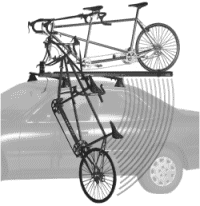 Roof mount racks
Roof mount racks systems offer versatility.
Pros:
- Offer flexibility for carrying several types of bikes, plus other sports equipment with optional accessories.
- Leaves the trunk/rear door accessible.
- Easy to install.
- Bikes on the rack do not touch each other or the automobile.
Cons:
- Must lift at least part of the bike onto the roof
- Must remember to remove the bikes before entering the garage
- Must know clearance height to avoid hitting anything overhead
 Trunk mount racks
Mounted on the rear of the vehicle, trunk mount racks are an economical choice.
Pros:
- Can be configured to fit multiple vehicles.
- Usually fold flat for compact storage.
Cons:
- Bikes can rub on each other or the car.
- Less security than other types of racks.
- Limit access to the truck/rear of the vehicle.
- May not fit your vehicle.
Other carrying systems
Spare tire mount racks are also available, and are similar to trunk mount racks.
Truck owners can use the ShuttlePad in the truck bed to secure up to six bicycles, as well as construction supplies and other sports gear.
Tips for choosing a carrying rack for your recumbent bicycle
Because of the wide range of frame configurations and wheelbase lengths on recumbent bicycles, not all racks are well-suited to carry recumbent bicycles.
Many of the racks designed to mount on the trunk or rear of the vehicle have holders that are made to be used with conventional bike frames. Sometimes these holders get in the way with recumbent bikes. Racks with simpler designs usually work better for recumbent bikes.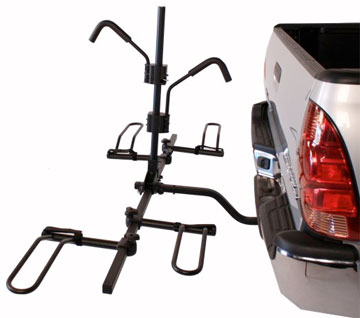 Look for a hitch-mounted rack that allows you to place the wheels of the bike in the rack rather than securing the bike by the frame. This takes less lifting and eliminates the problem of having the frame design interfere with your ability to mount the bike on the rack. Many of these bike racks, including the Hollywood Sport Rider Recumbent rack (pictured here), allow you to adjust to the wheelbase of your bike and to carry bikes with differing wheelbases.
If you are planning to carry your recumbent bike on a roof rack, you may need to remove the front wheel and the seat. We have roof racks that are extra long to accommodate long wheelbase recumbent bikes and tandems, which can’t usually be carried on standard roof racks.
Tips for transporting your recumbent trike
Since transporting a recumbent trike can be a challenge, they are best carried on racks designed for trikes.
If you have a hatchback, station wagon, minivan, SUV, or truck, many tadpole recumbent trikes and some delta-style recumbent trikes can be carried in the vehicle. This may mean that you can only have two passengers while you carry your trike, but can be a simple solution for many people. If you are shopping without your vehicle, bring your vehicle's measurements to the shop when you are selecting a recumbent trike.
Consider a roof rack or a hitch-mounted rack designed to carry a trike, such as the Alpaca rack, which can carry two tadpole-style trikes, such as those from Catrike.